
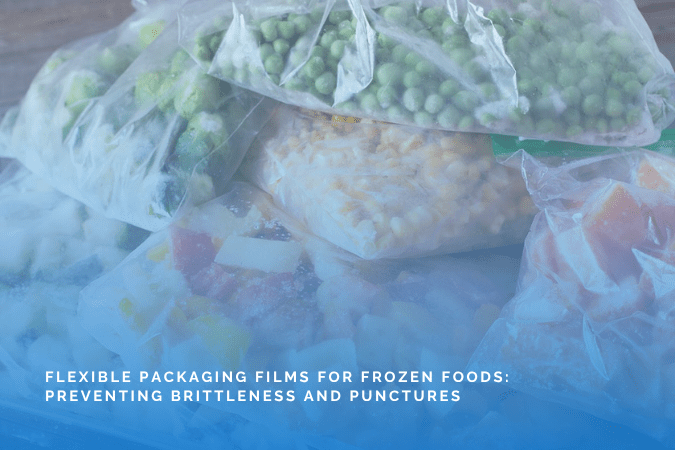
Flexible packaging films for frozen foods: Preventing brittleness and punctures
Most flexible films cope well at ambient or chilled temperatures. At -18°C and below, the same materials behave very differently, and that difference is where frozen food packaging problems tend to start.
When a film fails – through brittleness, cracked seals, or a puncture in transit – the cost goes well beyond wasted product. Retailer complaints and brand damage follow. Getting the specification right at the outset is considerably less painful than working out what went wrong after the fact.
Why frozen environments put flexible films under pressure
Most polymers become stiffer and less elastic as temperature drops. A film with enough give to run cleanly through a packaging line at ambient can crack or split once it is operating at frozen temperatures.
The result is embrittlement – a condition where the film loses the ability to flex and begins to crack under stress it would previously have absorbed. Seals are where this shows up most often. Stiffening at fold lines and corners compromises integrity, and once a seal goes, moisture gets in. There are, however, ways to avoid this by specifying high performance flexible films that are built to hold their physical properties at sub-zero temperatures to maintain flexibility and seal strength from the production line through to retail.
The main causes of brittleness and punctures
Not all failures originate with the film itself. The causes of damage in frozen packaging tend to fall into a few consistent categories:
- Material selection is the most significant factor. Using a film not rated for low-temperature performance is the fastest route to brittleness and cracking. Flexible packaging films for low temperatures, such as specialised PE, PET, laminated or co-extruded films, need to be specified with the cold chain in mind from the outset, not adapted from a standard ambient solution.
- Product geometry matters too. This should be considered at the packaging design stage. Frozen food products with sharp edges such as fish portions, breaded items and bone-in cuts place concentrated stress on the film during filling, handling and distribution. A pack that sits flat and stable on a line can behave very differently once it has been frozen, stacked and transported over distance.
- The production process itself can also be a source of damage. Filling speeds and sealing pressures that are poorly matched to the film specification can cause micro-damage before the product even reaches the freezer. So too can rapid changes in temperature, to minimise thermal shock products should be slowly brought down in temperature.
Materials and structures that perform at low temperatures
Material selection is where it starts. Cast polypropylene, low-density polyethylene and certain polyamide-based films retain useful flexibility at sub-zero temperatures and are typically used as the inner sealing layer in a multi-layer construction where each layer has a defined role.
Multi-layer laminates are the standard approach for demanding applications. An outer layer provides a print surface and mechanical protection; a barrier layer – often metallised or oxide-coated – controls moisture and gas transmission; and the inner layer seals to itself or to a tray. This structure allows the film to be engineered for puncture resistance, seal performance and low-temperature flexibility within a single construction.
Film gauge is a practical consideration that needs to be made alongside material choice. Heavier gauges offer more protection against sharp edges and impact but need to be balanced against runnability on the packaging line and overall material cost. Puncture resistant flexible films are typically the result of both the right polymer specification and an appropriate gauge – neither factor alone is sufficient.
Line compatibility, testing and print quality
A film can look right on paper but still cause problems in production. Seal temperature ranges, tension settings and tracking behaviour through a former all need to be confirmed before full production runs begin. Working with flexible film suppliers for food manufacturers who understand packaging machinery, not just material science, makes a considerable difference at this stage.
Testing under real cold chain conditions is equally important. Laboratory data provides a useful baseline, but performance testing that includes transit simulation at frozen temperatures gives a more complete picture of how a film will behave throughout its working life.
Print quality is another consideration, but one that is often underestimated in frozen food packaging. Products sit behind frosted glass in retail freezer cabinets, and the pack must work harder to communicate at that point of sale. Inks and adhesives used in frozen food flexible films need to be formulated for low temperatures to ensure colour consistency and adhesion hold up.
How the product itself appears on pack matters too – food photography that looks accurate and appetising at room temperature can shift noticeably under frozen conditions. A pack that looks vibrant at ambient can look flat or suffer delamination once frozen, and neither outcome reflects well on the brand.
Getting the balance right between durability, cold-chain performance, sustainability and cost is ultimately what good frozen food packaging specification comes down to.
Is your flexible film built for -18°C? Find your perfect match at Terinex Flexibles
Terinex Flexibles has been producing flexible films for the food industry in the UK for 20 years, with print capability built around high-speed flexographic presses. Alongside conventional laminate structures, we offer recyclable flexible films for frozen packaging for brands with sustainability targets to meet.
From standard specifications to bespoke flexible film solutions in the UK, Terinex Flexibles works with food brands and own-label suppliers to develop custom flexible films for frozen food that hold up across the entire cold chain – with the technical and print expertise to back it up.
Contact Terinex Flexibles to learn more.